Leave Your Message
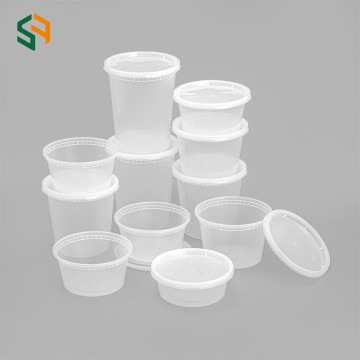
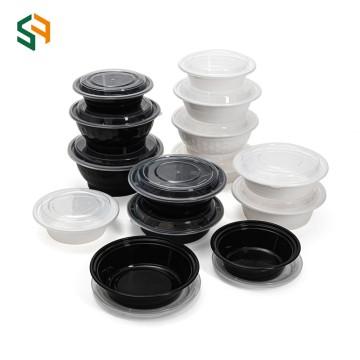
In the modern, fast-paced global economy, food packaging has transitioned from a mere container medium to a critical element of brand value, public health, and environmental sustainability. The Microwavable Container Round For Food Meal Prep And Portion Control sits at the intersection of these critical factors. The global meal prep delivery industry is experiencing exponential growth, fueled by rising health awareness, busy professional lifestyles, and the widespread adoption of customized diets. Round microwavable containers constructed from food-grade polypropylene (PP) and bio-based alternatives have emerged as the industry standard for commercial kitchens, institutional catering, and home meal prep enthusiasts alike.
Unlike rectangular containers where heat concentrates at the corners, round containers facilitate uniform microwave radiation absorption. This prevents localized overheating or cold centers, ensuring consistent food safety and quality during reheating.
From an industrial perspective, the production of microwavable round containers requires extreme precision. Positive-negative pressure automatic thermoforming machines integrated with high-speed robotic arms allow manufacturers to produce containers with uniform wall thickness. This structural uniformity is critical for load-bearing capacity during transportation and stacking. In commercial supply chains, food containers must withstand high vertical loads. When stacked in delivery vehicles or cold storage rooms, inferior containers risk collapsing, leading to product loss and contamination. Modern round designs incorporate reinforced rims and structural ribbing to maximize pressure resistance, making them ideal for high-volume logistics.
Furthermore, the food service industry is increasingly governed by stringent international food safety regulations. Materials must comply with FDA, LFGB, and EU standards. The transition to high-standard clean manufacturing environments (such as ISO Class 8 workshops) ensures that the containers are free from microbial contaminants, chemical residues, and dust particles right from the production line. This level of hygiene is indispensable for ready-to-eat (RTE) meal packaging and commercial food preparation factories.
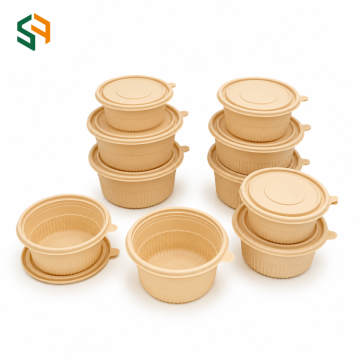
The global push towards carbon neutrality has fundamentally transformed the raw material supply chain. While modified food-grade Polypropylene (PP) remains highly popular due to its excellent heat resistance (withstanding temperatures up to 120°C/248°F) and recyclability, there is a massive surge in demand for bio-based and biodegradable materials. Corn starch composites and PLA (Polylactic Acid) formulations are being optimized to handle high temperatures, allowing them to be microwaved without losing structural integrity or releasing harmful toxins.
Vertical integration in manufacturing has allowed companies to control the entire sheet extrusion process. By modifying raw PP and blending it with natural bio-based polymers, manufacturers can drastically reduce the carbon footprint of each container. This satisfies both strict environmental mandates (such as single-use plastic bans in Europe and North America) and the corporate social responsibility (CSR) goals of multinational food brands.
Modern round containers are designed for multiple lifecycles. By engineering them to be dishwasher-safe and highly durable, they shift from single-use items to reusable household assets, directly aligning with global waste-reduction strategies.
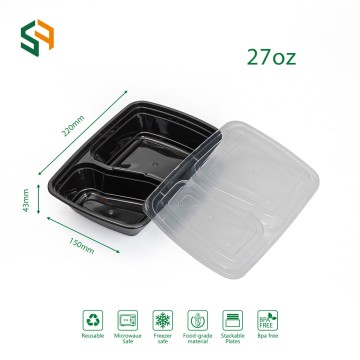
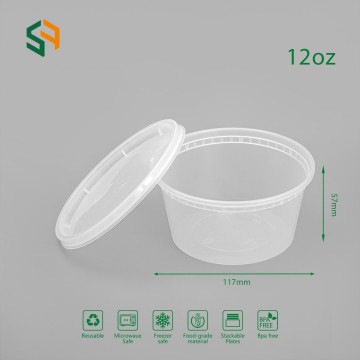
Portion control is no longer just a fitness trend; it is a critical component of medical nutrition therapy, corporate wellness programs, and consumer lifestyle management. Round containers are highly favored by dietitians and meal prep brands because their volumetric capacity can be precisely calibrated. Standardized sizes (such as 8oz, 12oz, 16oz, 24oz, and 32oz) allow meal prep companies to package precise macronutrient profiles (proteins, carbohydrates, and fats) for consumers.
In institutional settings, such as hospitals and senior care facilities, round sealed containers serve a dual purpose. They maintain food hygiene during transport across large complexes and allow staff to reheat meals quickly in commercial microwaves without transferring the food to plates. The airtight lids prevent cross-contamination and preserve the moisture content of the food, ensuring that nutrients are not lost during the reheating process. For consumer meal prep, the transparent or semi-transparent aesthetic allows users to identify meals instantly inside the refrigerator, optimizing meal planning and reducing food waste.
To be your trusted partner in sustainable food packaging – delivering high-value products, reliable quality, and excellent service.
With years of experience in disposable tableware, we use 100% compostable, bio-based, and biodegradable materials to reduce fossil fuel dependency. Precision manufacturing ensures every container is durable, safe, and able to return to nature responsibly. We are committed to a greener future – helping you serve meals in a way that protects both health and the planet.
When selecting a Microwavable Container Round For Food Meal Prep And Portion Control, businesses must analyze the mechanical properties of the packaging. Food-grade polypropylene (PP) is highly valued for its high melting point and chemical resistance. When food is microwaved, fats and sugars can reach extremely high temperatures. Lower-grade plastics can degrade or leach chemicals (such as BPA or phthalates) into the food. Our high-grade PP formulas ensure that the structural integrity of the container is maintained, and no chemical migration occurs, keeping food clean, healthy, and safe.
Additionally, leak prevention is a key technological focus. The design of the container rim and lid groove must be engineered with micro-precision. A dual-groove sealing mechanism ensures that even when liquid-heavy foods (such as soups, sauces, or dressings) undergo thermal expansion during transport or reheating, the lid remains securely attached. This leak-proof design is critical for meal prep services delivering food over long distances, ensuring the end consumer receives their meal exactly as it was prepared.
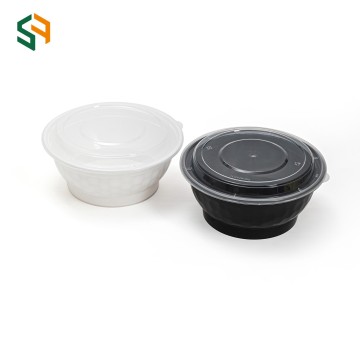
Many of our containers feature clear lids with anti-fogging coatings. This prevents condensation from clouding the lid, ensuring the food contents remain highly visible on retail shelves, directly boosting sales and consumer trust.
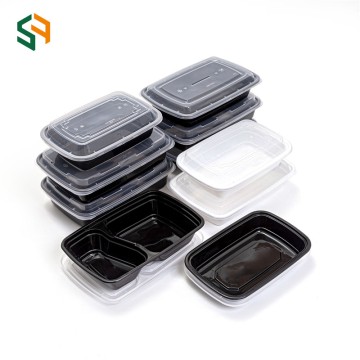
For large-scale food distributors, supermarket chains, and global meal prep brands, customization is key to brand identity. Our state-of-the-art production lines support custom mold creation, allowing brands to emboss logos, integrate specific compartment configurations, or choose custom colors that align with their brand identity. With a production footprint of over 17,000 m² of high-standard clean workshops, we can fulfill high-volume orders with short lead times, supporting global supply chains during peak seasonal demands.