Leave Your Message
Precision-manufactured round thermoformed and injection-molded solutions tailored for automated de-stacking, liquid-tight distribution, and end-consumer microwave rethermalization.
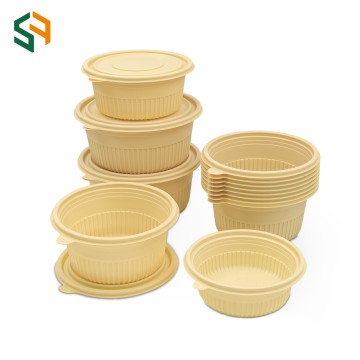
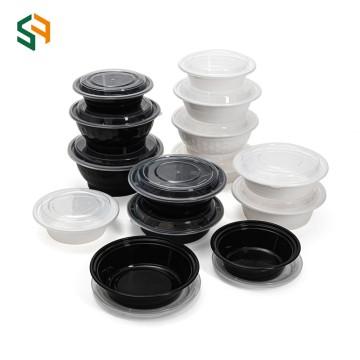
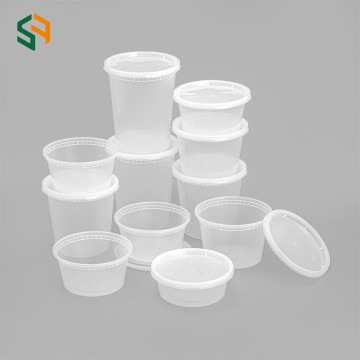
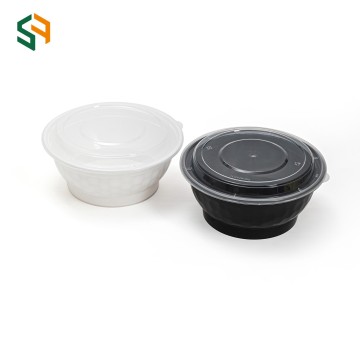
As central kitchens scale from regional commissaries into nationwide frozen food networks, the demand for packaging that seamlessly spans cryo-stability and dielectric heating has surged dramatically.
Industrial central kitchens utilize blast freezers operating at temperatures as low as -35°C to -40°C to lock in cellular moisture, flavor profiles, and nutritional integrity. Standard polymer containers undergo polymer chain embrittlement below their glass transition temperature ($T_g$), resulting in cracked flanges during transit. Our modified impact copolymer polypropylene incorporates elastomer-phase dispersion, preserving ductile impact strength and drop resistance under sub-zero conditions.
Rectangular vessels inherently suffer from the "corner overheating phenomenon," where concentrated microwave standing waves burn perimeter edges while leaving the center frozen. The engineered round geometry delivers uniform, radial electromagnetic absorption. Concentric heat dissipation prevents thermal degradation of proteins and sauces, allowing consumers and commercial operators to reconstitute prepared meals in up to 35% less time.
Commissaries and high-throughput packaging facilities operate rotary multi-station filling machinery exceeding 60–120 cycles per minute. Containers must possess exact dimensional tolerances, anti-vacuum rim ribs, and non-stick de-nesting lugs. Our precision thermoforming ensures zero robotic arm jams, smooth pneumatic separation, and reliable automated top-film heat sealing.
Engineered wall thickness distribution, stacking ring geometry, and food-grade barrier integrity converge to resolve the primary logistical vulnerabilities of prepared meal distribution.
In industrial central kitchens, ready-to-eat (RTE) and ready-to-heat (RTH) meals often combine complex ingredients with varying dielectric loss factors—such as dense starches, lipid-rich sauces, and fibrous proteins. When exposed to 2.45 GHz microwave radiation, square and rectangular food boxes cause electromagnetic focal points along the 90-degree corners, leading to premature boiling, edge-drying, and splattering while the center core remains frozen solid.
The continuous circular circumference of our round bowls promotes an uninterrupted circumferential wave path. When combined with rotating microwave turntables, standing waves penetrate the core with exceptional uniformity. This eliminates localized thermal degradation, cuts reheating energy expenditures, and ensures food-safety compliance across commercial reheating kitchens.
| Performance Attribute | Impact-Modified Round PP | CPET Round Bowls | Coated Bagasse / Paperboard | Aluminum Trays |
|---|---|---|---|---|
| Blast Freezing (-30°C) Durability | ✓ High Ductility | ✓ Excellent | ⚠ Risk of moisture softening | ✓ Excellent |
| Microwave Safe & Uniform Heating | ✓ Superior (Zero Arcing) | ✓ Good | ⚠ Moderate (Steam degradation) | ✗ Unsafe (Arcing & Sparking) |
| Liquid & Grease Hermetic Sealing | ✓ 100% Leak-Proof Snap/Film | ✓ Film Seal Only | ⚠ Wicking along raw edges | ⚠ Crimped mechanical folds only |
| Automated Line Speed (De-stacking) | ✓ Up to 120 units/min | ✓ Up to 90 units/min | ⚠ Static cling / Jam risks | ⚠ Fragile flange deformation |
| Total Packaging Unit Economics | ✓ Most Cost-Effective | ⚠ High Cost Premium (2x-3x) | ⚠ Medium to High | ⚠ Moderate, Energy-Intensive |
Optimized configurations engineered for the exact chemical, logistical, and mechanical demands of modern industrial catering.
High-viscosity liquids and high-fat curries exert severe hydrostatic pressure during vehicle transit and expand significantly upon phase transition during freezing. The perimeter bead rib design accommodates liquid expansion without buckling the lid seal.
Hospitals and airline kitchens demand precise volumetric portioning, ultra-hygienic automated assembly, and rapid conveyorized microwave regeneration carts. Our cleanroom-manufactured containers ensure zero microbial contamination.
Subscription meal-prep models ship insulated boxes packed with dry ice (-78.5°C) directly to residential consumers. The specialized copolymer additive resists extreme cryogenic fractures caused by direct sublimating carbon dioxide contact.
To be your trusted partner in sustainable food packaging – delivering highvalue products, reliable quality, and excellent service.
With years of experience in disposable tableware, we use 100% compostable, bio-based, and biodegradable materials to reduce fossil fuel dependency. Precision manufacturing ensures every container is durable, safe, and able to return to nature responsibly.
We are committed to a greener future – helping you serve meals in a way that protects both health and the planet.
Two decades of manufacturing excellence: From specialized precision industrial blister packaging to cutting-edge cleanroom food container automation.
Detailed technical answers for packaging engineers, central kitchen directors, and supply chain managers.
Standard homopolymer polypropylene turns brittle around 0°C. Our containers utilize an advanced impact copolymer compounded with fine ethylene-propylene elastomer rubber phases. This alters the internal crystal morphology, preventing micro-crack propagation under intense thermal shock and dynamic drop stresses.
Microwaves penetrate materials from multiple directions. In rectangular vessels, microwaves converge at corners, burning localized areas while the core stays frozen. Round bowls exhibit uniform radial geometry that allows rotating waves to heat foods symmetrically without corner overcooking.
Yes. Every container features a flat, smooth, ultra-consistent flange profile specifically engineered for heat-sealing machines and Modified Atmosphere Packaging (MAP) equipment, ensuring a hermetic seal against oxygen ingress and vacuum collapse.
All containers are manufactured from 100% virgin, food-grade polypropylene and bio-based resins. They are completely BPA-free, phthalate-free, and comply with FDA 21 CFR 177.1520 and EU Regulation 10/2011 overall migration testing up to 121°C.
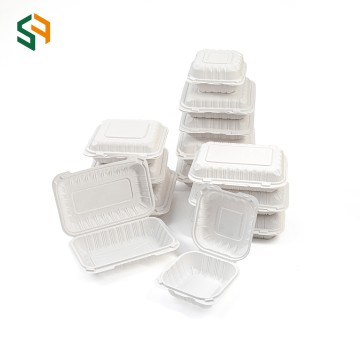
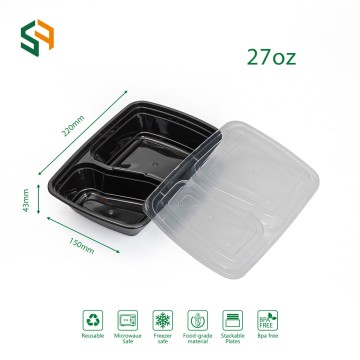
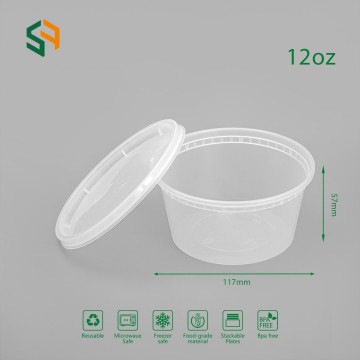
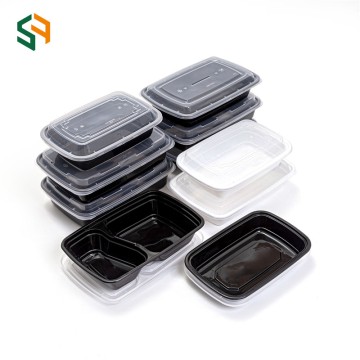
Explore our full line of round bowls, multi-compartment containers, hinged clamshells, and deli vessels engineered for professional cold-chain food services.